
E-House Structural & Lifting Analysis
The client required independent verification of the structural integrity and lifting arrangements for modular low-voltage, medium-voltage and transformer E-House units before transportation and installation.
The units had different mass distributions and internal equipment layouts, creating different reactions at the lifting points and supporting structural members.
The assessment considered approximate unit weights of 11 tonnes for the LV module, 7.5 tonnes for the MV module and 23.5 tonnes for the transformer module.
The lifting condition was assessed using the unit dead load together with a 1.5 load factor to represent the specified factored lifting condition.
- LV module
- Approximately 11 tonnes
- MV module
- Approximately 7.5 tonnes
- Transformer module
- Approximately 23.5 tonnes
- Lifting assessment
- Dead load with a 1.5 load factor
CITA Engineering reviewed the proposed lifting arrangement, module geometry, internal equipment distribution and available structural information before developing finite element models for the three E-House units.
The analysis evaluated global module behaviour, frame deformation, lifting-point reactions and local stresses in the supporting members, lifting rods and associated interfaces.
The finite element assessment indicated that the LV and MV module structures remained within the acceptable limits applied to the assessed lifting conditions.
The transformer unit presented the more critical case because of its higher mass and eccentric load distribution. Elevated stresses were identified in the proposed transformer lifting rods, indicating that the original arrangement did not provide sufficient margin for the factored lifting condition.
CITA recommended strengthening the critical lifting components, including upgrading the relevant material specification from S235 to S275 where applicable and reviewing the lifting-rod and local connection details.
The findings were issued in an engineering-assurance report with recommendations for implementation before lifting.
Finite element models were developed to assess the global structural response, deformation, lifting-point reactions and local stress behaviour of the three modular E-House units.
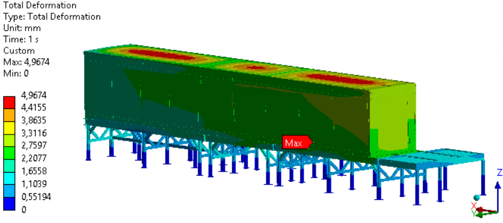
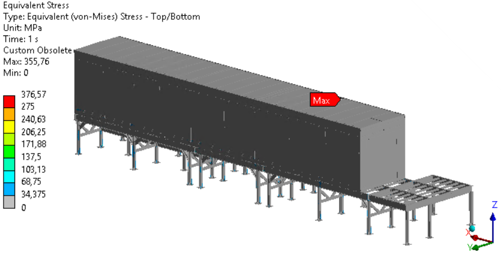
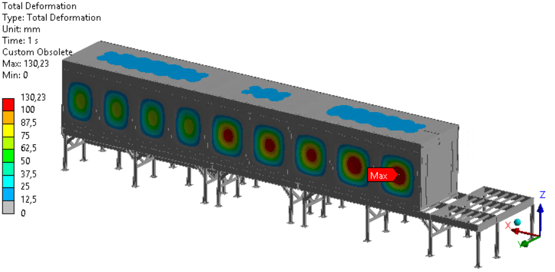
The LV and MV lifting arrangements were assessed as suitable for the applied project conditions. The transformer module presented the critical case, with elevated stresses identified in the proposed lifting rods. CITA recommended strengthening the critical components and reviewing the lifting-rod and local connection details before lifting.
The assessment confirmed the suitability of the LV and MV lifting arrangements and identified a critical weakness in the transformer-unit lifting system before the lift occurred.
The recommended improvements reduced the risk of local yielding, structural damage and unsafe load transfer during handling and installation.
More work in the Energy sector.
Need assurance-led engineering support on a live asset or project?
Book a technical consultation to discuss scope, risk profile, project stage, and the most appropriate support model.